

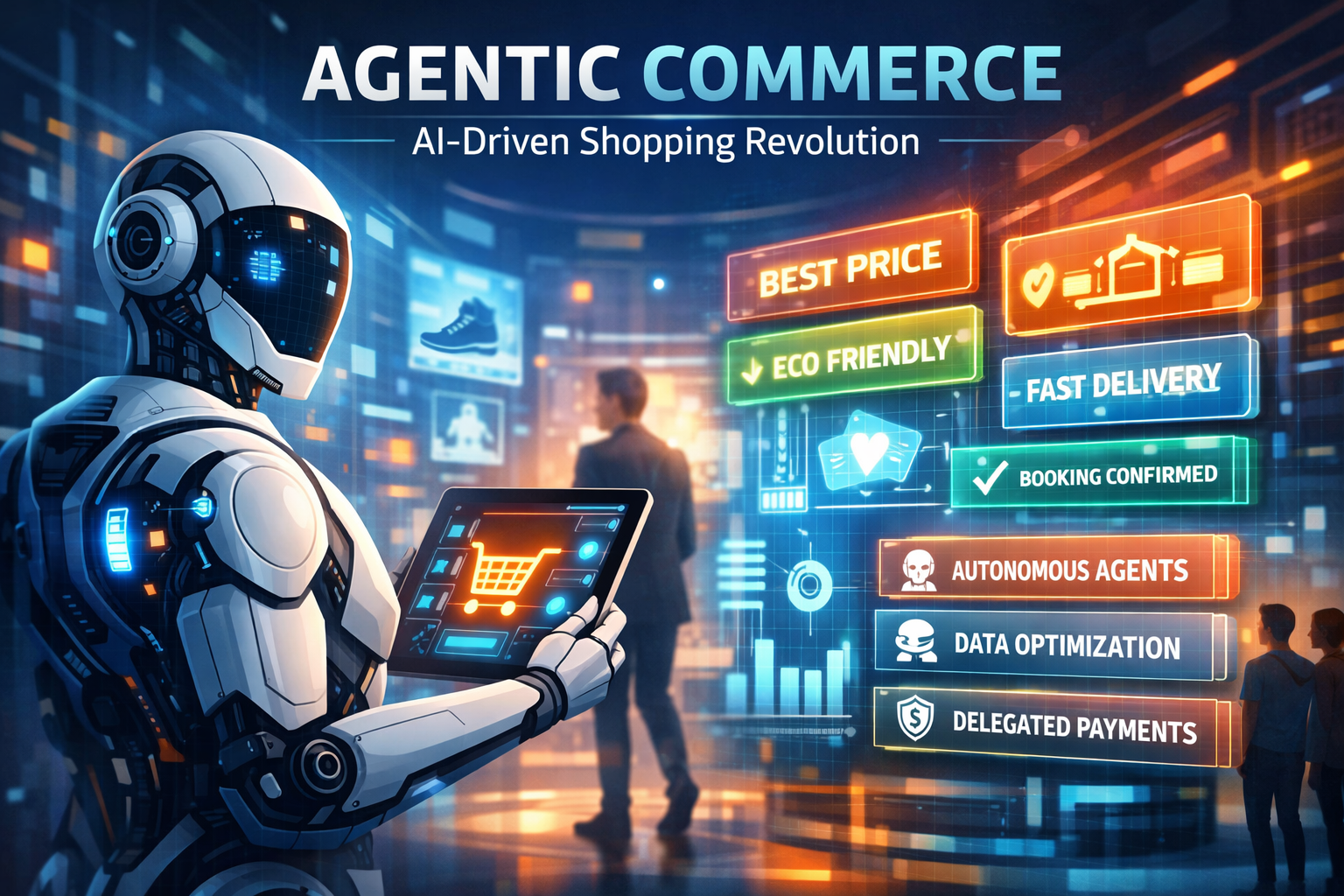
Tomorrow, the act of purchasing as we know it will no longer be the result of a human navigating a visual interface. It will be the outcome of a mission delegated to an AI Agent.
Whether booking train tickets, replenishing office supplies, or managing store inventory, these autonomous agents will compare, negotiate, and execute transactions according to price criteria, ESG policies, and delivery speed.
This shift from E-Commerce to A-Commerce radically transforms the merchant’s role: it is no longer about seducing the human eye, but about convincing an algorithm by responding precisely to preferences defined by the end user.
The Strategic Posture Shift: From Attention to Performance
For merchants, this transformation requires a new strategic posture — optimized for a sales channel governed by algorithms.
Traditional user experience, built around human senses and the aesthetics of web or mobile interfaces, fades into the background. What prevails now is pure performance and data reliability.
In this new paradigm, success no longer depends on the smoothness of a visual conversion funnel, but on the efficiency of Agentic Execution.
Merchants must now focus on AEO (Agentic Engine Optimization) — ensuring their products and services are the most visible, structured, and attractive to AI agents, much like SEO shaped visibility in search engines over the past two decades.
The Value Chain Transformation and the Rise of Gatekeepers
Within this emerging system, a completely new value chain is redefining power dynamics in retail.
Providers such as OpenAI, Anthropic, or Google are no longer simple search tools. They are becoming true gatekeepers, orchestrating access to the consumer.
These platforms now hold immense influence over brands’ conversion capabilities.
At the same time, the concept of the “Life Concierge” introduces a shift from product search to complex problem resolution. The merchant no longer interacts with a searching customer, but with an agent solving a sophisticated logistical and financial equation — placing interoperability at the top of strategic priorities.
The Invisible Infrastructure Governed by Protocols and Standards
The rationalization of this ecosystem depends on the adoption of universal connectivity protocols and standards.
Merchants must comply with these emerging norms to remain competitive.
Robust, high-performance, ultra-structured APIs become the vital foundation of any commercial activity. Ideally built on a headless model, this infrastructure allows agents to interact seamlessly with merchant systems, free from the constraints of rigid interfaces.
Technical excellence and real-time data availability become the new key selling points in attracting AI purchasing agents.
Delegated Payment: From Human Authentication to Machine Identity
The financial dimension of this revolution is arguably the most critical for finance and technology leaders.
Payment becomes fully delegated to the AI agent — shifting the security paradigm entirely.
Traditional protocols like 3D Secure, designed for human interaction, give way to secure machine identity frameworks.
This new architecture relies on delegated financial authority and programmable credentials capable of autonomously validating transactions. Trust no longer resides in multi-factor authentication processes, but in the robustness of authority delegation protocols and machine-specific payment token management.
The Brand Paradox and the Risk of Commoditization
A fundamental question arises for every executive: how do you preserve brand value when the interface is standardized by AI?
The risk is becoming a mere commodity supplier — stripped of emotional connection with the end customer.
To counter this, brands must ensure that AI systems integrate qualitative attributes and brand values into their decision-making logic.
The challenge is to inject brand DNA directly into data structures and APIs, enabling AI agents to recognize loyalty programs, premium services, or exclusive benefits that distinguish the merchant within an ocean of algorithmic performance.
What Comes Next
The era of Agentic Commerce is no longer speculative. Its deployment will directly impact your revenue in the years ahead.
To avoid exclusion from this emerging economy — and to turn disruption into growth — your immediate priorities must be twofold:
First, cleanse and structure your product data so that it becomes perfectly readable by AI agents. This is the essence of AEO (Agentic Engine Optimization).
Second, open your information systems through secure and robust APIs, ensuring seamless interaction with third-party ecosystems.
On this foundation, we can collectively address the deeper challenges of your transformation. Because while tomorrow’s buyer will rely on agents to decide, the merchant must also leverage AI to negotiate, respond, manage orders, and process transactions autonomously.




 ITOPYX